.svg)


THE EXPERIENCE CRISIS
According to research from the Alliance for Lifetime Income, we're in the middle of "Peak 65" - approximately 4.1 million Americans reaching retirement age annually through 2027.
But the numbers don't capture what we're actually losing.
We're losing:
- Master negotiators who've brokered hundreds of deals and can read power dynamics most people can't see
- Manufacturing engineers who can hear when a machine is about to fail, days before diagnostics catch it
- Sales leaders who've built twenty high-performing teams and know exactly when to coach and when to let someone figure it out
- Healthcare professionals who can spot complications before they appear on any monitor
Each person represents decades of accumulated judgment that took a lifetime to build.
And we have no way to transfer it.
KNOWLEDGE VS. EXPERIENCE: THE FUNDAMENTAL DIFFERENCE
Knowledge transfers relatively easily. You can write it down. Teach it in a classroom. Put it in a training manual.
Experience is different.
The philosopher Michael Polanyi described this as "tacit knowledge" - we know more than we can tell.
That ER nurse can't write a document called "How to Know When a Patient Will Crash." She just knows. After 38 years and tens of thousands of patients, the pattern recognition happens below the level of conscious thought.
This has happened throughout history:
- Roman concrete: Stronger than modern concrete, the recipe was lost for over a thousand years
- Stradivarius violins: We still can't recreate instruments made 300 years ago
- Traditional medicine: Disappears when the last elder who holds it dies
The difference now is scale. We've never had this many experienced people retiring at once. The baby boomer generation represents the largest cohort of experienced professionals in human history - and they're all leaving within the same narrow window.
WHAT ACTUALLY DISAPPEARS: THE THREE FORMS OF EXPERT EXPERIENCE
When an expert retires, here's specifically what the world loses:
1. Pattern Recognition
After seeing the same situation a thousand times, you can predict what happens next before anyone else sees it coming.
A master salesperson has been in a thousand sales conversations and can sense where this one is headed in the first three minutes. A seasoned project manager has seen a hundred projects start to derail and knows the early warning signs others miss entirely.
This recognition happens fast, often unconsciously, and is nearly impossible to articulate.
2. Contextual Judgment
Knowing when the rules apply and when to break them.
A junior employee reads the crisis communication playbook and follows it exactly. An expert who's managed fifty crises knows when to follow the playbook and when the situation demands something different.
That judgment can't be captured in a document.
3. Embodied Wisdom
The ER nurse who senses a patient is about to crash. The engineer who can hear machinery problems. The therapist who knows a client is hiding something important.
This isn't mystical - it's the result of processing thousands of subtle signals over thousands of hours. But it lives in the body, in intuition, in a way that resists transfer.
THE COST OF THE EXPERIENCE GAP
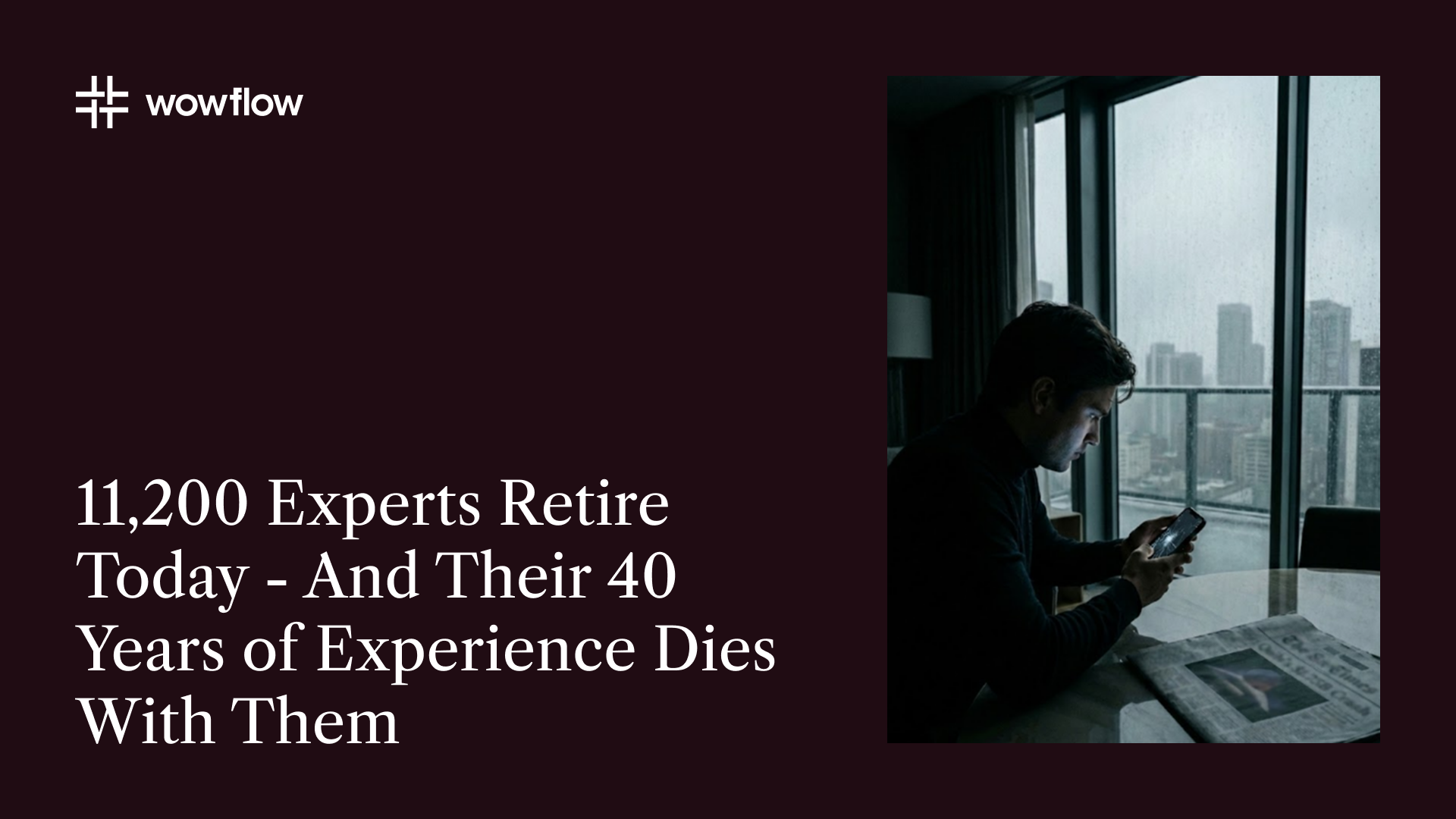
Every day, 11,200 experts retire. Multiply that by decades of accumulated experience, and the numbers become staggering.
Research from Panopto shows companies lose $47 million annually due to the experience gap. Fortune 500 companies collectively lose $31.5 billion per year.
Here's what that looks like in practice:
People who've never navigated complex situations are now handling them for the first time - without access to how the best in the world learned to do it. They know the frameworks. They've had the training. But when the critical moment hits, they're making decisions someone with 20 years of lived experience would handle completely differently.
The gap between knowing what to do and executing like someone who's done it a thousand times is where revenue disappears.
Deals get lost in final negotiations. Projects derail because warning signs go unrecognized. Customer relationships end because no one spotted the early signals. Problems that veterans would diagnose in minutes take days to solve.
Not because people aren't smart or trained. Because they haven't lived through those moments enough times to develop the pattern recognition and judgment that only experience builds.
Calculate Your Experience Gap - 60 Second Assessment
A DIFFERENT QUESTION
Here's a different question: What if experience didn't have to die with the expert?
What if, instead of losing 11,200 lifetimes of accumulated experience every day, we could capture how the best in the world handle critical moments? Not in a static document that no one will read, but in a way that makes it accessible exactly when someone else needs it?
Imagine this:
You're navigating your first high-stakes negotiation. The buyer goes silent after your proposal. You're not sure if this is normal or if you're losing the deal.
In the traditional world, you're on your own. Maybe you ask your manager. Maybe you guess.
But what if you could access what someone who's done this 2,000 times learned?
Not a generic framework. Specific guidance: "This silence is a pattern. It usually means they're building an internal business case. Here's what it means, and here's what to do next."
You just gained 40 years of experience in that moment.
EXPERIENCE INTELLIGENCE: CAPTURING EXPERTISE BEFORE IT'S GONE
For the first time in history, we can capture and transfer expert experience at scale.
At Wowflow, we've built an Experience Intelligence Platform that does exactly this. We capture world-class expert experience - how the top 1% of performers actually handle critical business moments - and deliver that lived experience to your team exactly when they need it.
Here's how it works:
We work with elite performers who've mastered critical moments through thousands of repetitions. A closer who's done 2,000 enterprise deals. A customer success leader who's saved hundreds of at-risk accounts. A project manager who's rescued 50 derailing initiatives.
We capture how they actually handle these moments - not what they'd write in a playbook, but the real pattern recognition, contextual judgment, and decision-making they've developed through lived experience.
Then we deliver that experience to your team in real-time, exactly when they face that critical moment for the first time.
The result:
Not after the expert retires. Before their expertise is lost.
Not locked in one person's head. Accessible to your entire team.
Not generic training. Real-world experience from the best in the world.
This is how we close the Experience Gap - by making world-class performance accessible to everyone, not just those lucky enough to have lived through thousands of high-stakes situations.
See How Experience Intelligence Works
THE CLOSING WINDOW
We're in a unique moment in history.
The largest generation of experienced professionals is still active. Still accessible. The technology to capture and transfer their lived experience finally exists.
But this window won't stay open long.
In ten years, most of these experts will have retired. Their experience will be gone. We'll spend the next several decades trying to rebuild what we lost, wondering why the new generation seems less capable - not realizing that we failed to preserve the accumulated wisdom of the previous one.
CONCLUSION
The experts are retiring whether we're ready or not. The only question is whether their experience dies with them.
Every day we wait, we lose another 11,200 lifetimes of accumulated wisdom. Every week, the equivalent of a small city's worth of expertise. Every month, nearly half a million experts.
This isn't just a business problem. It's a civilizational challenge.
The good news? For the first time in history, we have the technology to solve it.
The question is whether we'll act before it's too late.
Subscribe to Close the Gap Newsletter
SOURCES
Primary Research:
- Alliance for Lifetime Income: "Peak 65 Zone" research report
- Panopto: "$47M Annual Loss" due to experience gap
- Harvard Business Review: "What's Lost When Experts Retire"
- Polanyi, Michael: "The Tacit Dimension" - foundational work on tacit knowledge
.png)