.svg)

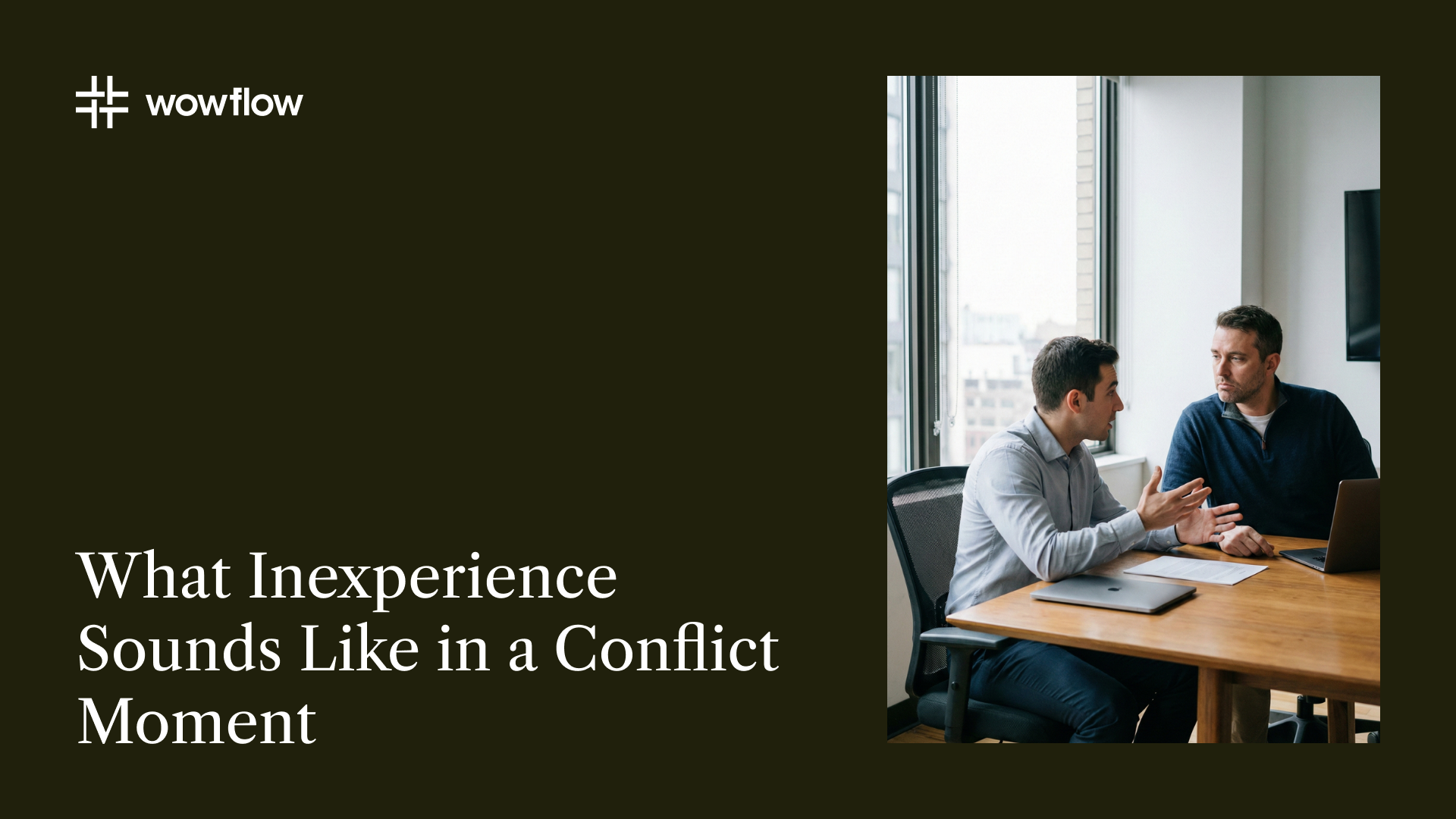

CONFLICT IS WHERE DEALS BREAK
Most sales leaders focus on preparation. On discovery. On the demo.
But deals don't usually break there.
They break in the conflict moments. When a prospect raises a concern, challenges a claim, or shares something they heard. When the conversation stops being smooth and starts requiring real judgment.
Here is what the data says.
44% of sales reps give up after the first objection.
Not after five. Not after three. After one.
The prospect raises a concern and nearly half of all reps either fold, go defensive, or disengage. The deal dies not because the objection was unsolvable but because the rep did not have the experience to navigate it.
And those moments come up constantly.
The average sales rep hears 10 objections every single day.
Ten times a day, a prospect pushes back. Raises a concern. Challenges something. Shares a doubt.
That is ten chances every day to either save a deal or break one.
The problem is that only 27% of salespeople are able to overcome objections effectively.
So 73% of your team is walking into those moments without the experience to navigate them. Ten times a day. Every day.
The math is not complicated. The result is not surprising.
What is surprising is how clearly the gap shows up when you look at what separates the people who can handle conflict from the people who cannot.
Sales experts are 843% more likely to overcome objections than average reps.
Not 20% better. Not twice as good. 843% more likely.
That gap is not about technique. It is not about memorizing the right script. It is about having the pattern recognition that only comes from experiencing hundreds of these moments before. Knowing what the objection actually means. Knowing what the prospect really needs to hear.
WHAT INEXPERIENCE SOUNDS LIKE IN CONFLICT MOMENTS
The mistakes are consistent. They show up in almost every inexperienced rep the same way.
"That's not true."
A prospect says something negative about your product. Maybe something they heard. Maybe a bad experience from a former customer. Maybe a misunderstanding.
The inexperienced rep hears: attack.
Their instinct is to defend. To correct. To push back.
"That's not accurate." "That's not what we do." "I don't know where you heard that."
It feels like the right move. They are protecting the product. Setting the record straight.
But the prospect does not experience it that way. They experience a rep who got defensive the moment they raised a concern. A rep who cared more about being right than understanding what was behind the objection.
Trust breaks in that moment. And once trust breaks in a sales conversation, it rarely comes back.
A sales expert hears the same objection and responds completely differently.
"Tell me more about what you heard. I want to understand what you are referring to."
That one shift changes everything. Instead of a confrontation, it becomes a conversation. The expert finds out what is actually behind the concern. The prospect feels heard instead of argued with.
Same objection. Completely different outcome.
"Let me see what I can do on price."
A prospect pushes back on price. Or mentions a competitor. Or says the budget is tight.
The inexperienced rep hears: we might lose this deal.
So they discount. Immediately. Before understanding what the objection is actually about.
But the objection was not really about price. It was about risk. Or ROI. Or internal approval. The discount does not address any of that. It just tells the prospect that your pricing was inflated to begin with and that you will fold the moment they push.
A sales expert does not discount at the first sign of resistance. They probe. They find out what is really behind the pushback. The discount only comes if it is actually what solves the problem.
"Great question. What we typically see is..."
Every rep has been trained on objection handling. They know the framework. They have practiced the responses.
So when the objection comes, they deliver the response. Word for word. Exactly as practiced.
The prospect can feel it immediately. The answer does not match their specific concern. It is a generic response to a generic version of what they said.
Scripts give you the shape of a response. Experience gives you the ability to actually hear what someone is saying and respond to that specific thing.
Without that experience, the script sounds hollow. The prospect disengages.
WHY THIS HAPPENS
Inexperienced reps do not handle conflict poorly because they have not been trained. Most of them have. They know the frameworks. They have heard about active listening. They have practiced objection handling in role play.
But when the actual moment comes, they revert.
Because in a real conversation, with a real prospect, under real pressure, training competes with instinct. And instinct wins.
Inexperienced instinct says: this feels like an attack, defend yourself. This feels like they are about to leave, offer them something.
Expert instinct says something different.
Sales experts have been in this exact moment hundreds of times. They have seen what happens when you get defensive. They have watched deals die that way. They have also seen what happens when you ask one good question instead.
That history is what changes the instinct.
An inexperienced rep hears: "Your implementation takes six months and never works" and thinks: attack, defend.
A sales expert hears the same words and thinks: concern that needs to be understood. Probably signals a real fear about risk or wasted budget. Needs a question, not an answer.
That difference does not come from a training session. It comes from having lived through the moment enough times to know what it actually means.
THE REVENUE IMPACT
The numbers connect directly to what happens in these moments.
44% of reps give up after the first objection. Those are not deals lost because the product was wrong or the price was too high. They were lost in the conflict moment. When the concern came up and the rep did not have the experience to stay in it.
The 843% gap between expert objection handling and average rep performance shows up directly in win rates. The average B2B win rate sits at 21%. Sales experts close at 30% or higher. Most of that gap traces back to moments exactly like this one.
And the damage compounds.
When a rep handles conflict poorly, it is not just that deal that suffers. Trust, once broken, does not recover in that conversation. The prospect leaves with a different impression of your company than they would have had with someone who knew how to handle that moment.
One objection mishandled. One deal lost. One prospect who tells someone else what the experience was like.
CLOSING THE EXPERIENCE GAP IN CONFLICT MOMENTS
Here is what changes when your team has expert-level judgment in conflict moments.
The concern comes up. The prospect says they heard something negative. Or pushes back on price. Or challenges a claim.
Instead of defending, your rep asks. "Tell me more about what you heard."
Instead of discounting immediately, your rep probes. "Help me understand what is behind the budget concern."
Instead of delivering a canned response, your rep listens. Actually listens. Then responds to what was actually said.
These are not complicated moves. But they require the pattern recognition that only comes from experience. From having been in enough of these moments to know what they actually mean and what actually works.
When your team has that judgment available to them in the moment, the 44% of deals lost to reps giving up after the first objection starts to shrink. The 843% gap between experts and average reps starts to close.
The objections will keep coming. Ten a day, every day.
The question is whether your team is handling them with experience or figuring them out live.
CONCLUSION
Objections are not rejections.
Every sales expert knows this. A prospect who raises a concern is still in the conversation. Still thinking about it. Still giving you a chance.
But that chance disappears the moment your rep handles it wrong.
When they get defensive, the prospect shuts down. When they discount immediately, they lose the trust and the margin. When they deliver a script, the prospect feels like a number, not a conversation.
44% of reps give up after the first objection.
Only 27% of salespeople can overcome objections effectively.
Experts are 843% more likely to get through them.
The gap is real. And it shows up ten times a day, every single day your team is in front of prospects.
Conflict moments do not have to break deals. With expert-level judgment in the room, they can actually build trust. A concern handled well tells a prospect: this team listens, this team understands, this team can be trusted.
That is what experience transfer makes possible. Not just in the prep. Not just in the close. In the moment when it is hardest. When the conflict comes and the rep has three seconds to decide how to respond.
Close the experience gap. Stop losing deals to conflict moments.
See How Wowflow Delivers Expert Judgment in Conflict Moments
Already know your team is struggling with objections? See exactly what it is costing you.
RESOURCES
Objection Handling Statistics
- 44% of sales reps give up after the first objection (RAIN Group, 2024) https://spotio.com/blog/sales-statistics/
- Average rep hears 10 objections per day (HubSpot) https://seamless.ai/customers/blog/sales/sales-objections
- Only 27% of salespeople can overcome objections effectively (HubSpot / Seamless.AI) https://seamless.ai/customers/blog/sales/sales-objections
Performance Gap
- Top performers 843% more likely to overcome objections (Ebsta x Pavilion 2024) https://developmentcorporate.com/saas/2024-b2b-sales-benchmark-report-why-top-performers-win-deals-and-average-reps-lose-in-the-u-s-u-k-and-global-markets/
Win Rate Benchmarks
Average B2B win rate: 21%, experts 30%+ (HubSpot 2024) https://blog.hubspot.com/sales/sales-statistics
.png)